Forward Deployed Engineer vs Software Engineer vs Solutions Engineer: Same Stack, Different Jobs
Forward deployed engineer vs software engineer vs solutions engineer: same tools, different jobs. What differs is who is paged when production breaks.
Executive summary
- For a VP Engineering or CTO weighing forward deployed engineer vs software engineer vs solutions engineer for a stalled customer deployment: which role fits the gap, and what to check before you hire or buy one.
- The three roles share a stack. They differ in who they serve: a software engineer serves every customer, a solutions engineer serves one deal, and a forward deployed engineer serves one customer in production.
- The test that separates them is who gets paged when the customer's system breaks after go-live. Only the forward deployed engineer does.
- Pay is not the difference. Levels.fyi medians for the three sit within $20,000 of each other, so choose by the job, not the cost.
Forward deployed engineer vs software engineer vs solutions engineer is a question about accountability, not skill. All three write code, read logs and talk to customers. What differs is whose problem they own and when they are done. If you need what a forward deployed engineer is first, start with our guide; this piece compares the three roles for the person deciding which one to put in front of a customer.
What is the difference between a forward deployed engineer, a software engineer and a solutions engineer?
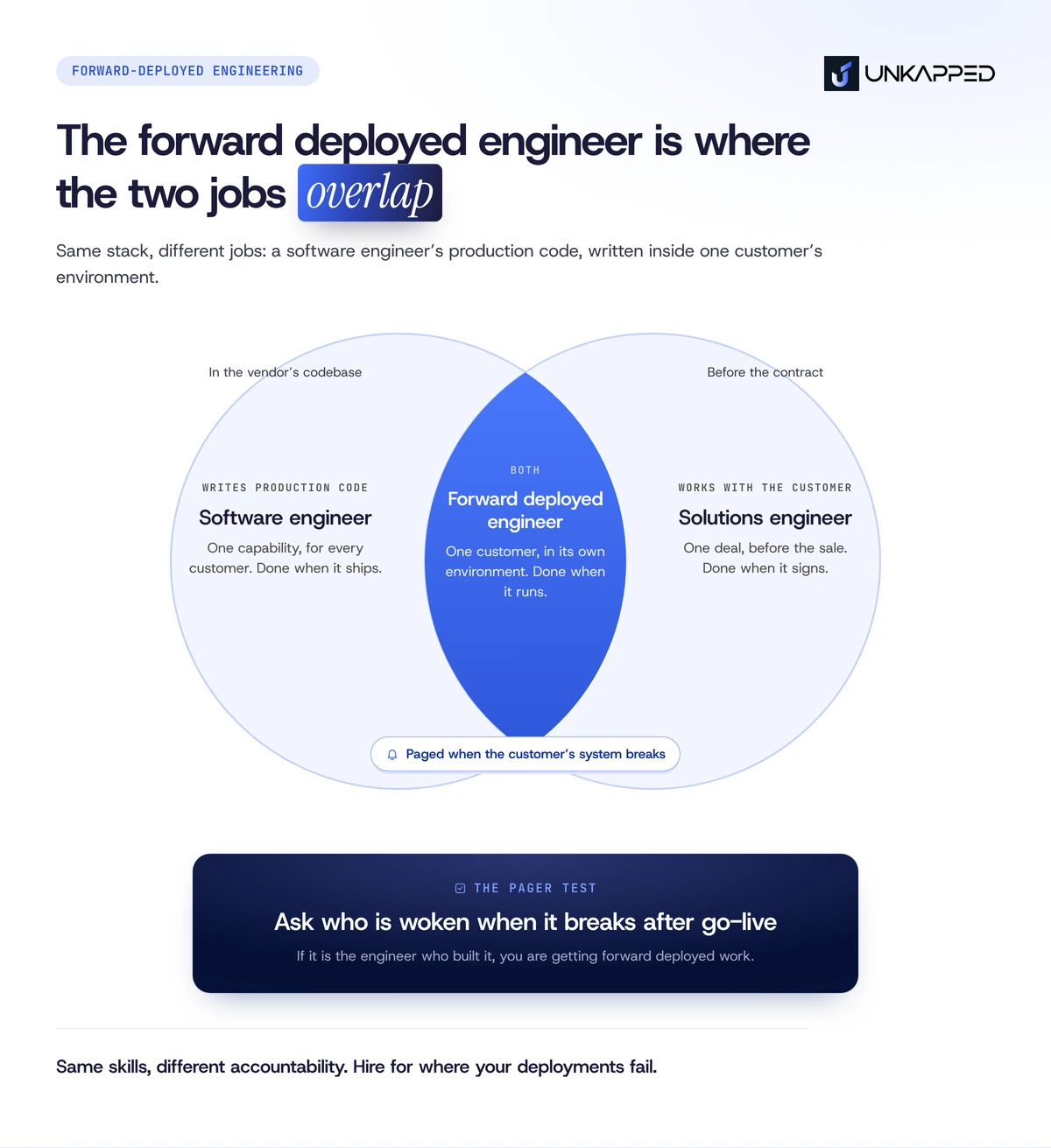
A software engineer builds one capability for every customer and is done when it ships. A solutions engineer proves the product fits one prospect and is done when the deal closes. A forward deployed engineer builds what one customer needs in its own environment and is done when it runs in production, and keeps running.
The last row is the one to read. It is the pager test: whoever is woken when one customer's deployment fails owns that customer's outcome. Titles drift between companies. The pager does not.
Forward deployed engineer vs software engineer: how do the roles differ?
A forward deployed engineer works on one customer across many capabilities; a software engineer works on one capability across many customers. Palantir, which created the role, frames its Devs and Deltas exactly this way. The skills overlap almost completely. The direction of the work does not.
Palantir calls its software engineers Devs and its forward deployed software engineers Deltas. As The Pragmatic Engineer quotes it, a Dev's focus is one capability for many customers, and a Delta's is one customer for many capabilities. That one line explains most of what else differs.
A software engineer inherits a defined problem. A product manager has done the discovery, the ticket says what to build, and the code goes through review into a product every customer runs. The engineer can go deep in one area for years.
A forward deployed engineer inherits an undefined one. The customer's data is messier than the demo, the integration nobody mentioned is the one that matters, and the definition of done moves until the system works. The engineer goes wide across one customer's stack and brings back what the product is missing.
The two roles need each other. The forward deployed engineer finds the workaround every third customer needs; the software engineer turns it into a feature so the fourth customer does not need a forward deployed engineer at all. A company with only one of the two either ships a product nobody can deploy or deploys work nobody can maintain.
How is a forward deployed engineer different from a solutions engineer?
A solutions engineer works before the sale and proves the product can work; a forward deployed engineer works after the sale and makes it work. The solutions engineer is measured on the deal. The forward deployed engineer is measured on the customer's system running in production, and is the one paged when it stops.
The overlap is real, which is why the rebrand complaint keeps coming up. Both roles sit close to customers, both write code that is specific to one account, and both translate between the customer's problem and the product. Plenty of vendors have retitled solutions engineers as forward deployed engineers because the title is in demand.
The pager test settles any single case. Ask who is called at 2am when the customer's pipeline stops after go-live. If the answer is a support queue, then a product team, then maybe the person who sold it, you are buying solutions work with a new title. If the answer is the engineer who built it, you are buying forward deployed work. Our main forward deployed engineer guide adds two more markers: whose data the work runs on, and whose repository the code lives in.
Neither role is better. A team that keeps losing deals at the technical evaluation needs a solutions engineer. A team that keeps winning deals and then watching deployments stall needs a forward deployed engineer.
TL;DR: In forward deployed engineer vs software engineer vs solutions engineer, the difference is accountability. A forward deployed engineer is accountable for one customer in production; a software engineer for one capability everywhere; a solutions engineer for one deal. When a title is unclear, ask who is paged after go-live.
How do solutions engineers and software engineers differ?
A software engineer builds the product; a solutions engineer shows a prospect what the product can do for them. The software engineer writes code that ships to everyone and must be maintained for years. The solutions engineer writes code that wins one evaluation and can usually be thrown away afterwards.
The difference shows in what each optimizes. A software engineer optimizes for code that is correct, tested and maintainable by someone else. A solutions engineer optimizes for a convincing proof on the prospect's problem, built fast, often on sample or anonymized data. Each would be wrong to work the other's way: a production-grade proof of concept loses the deal to a faster competitor, and a demo-grade feature becomes next year's incident.
Solutions engineers usually report into sales and are often measured partly on revenue. Software engineers report into engineering and are measured on delivery and reliability. That reporting line is the clearest single signal of which role you are looking at.
Do forward deployed engineers, software engineers and solutions engineers get paid differently?
Not much. On Levels.fyi, US median total compensation for the three roles sits within $20,000 of each other, so pay should not decide which role you hire or which you choose. Company and level move compensation far more than the title does.
Levels.fyi does not publish a separate "solutions engineer" title median, so sales engineer and solution architect stand in for it, next to the software engineer median. All figures are self-reported and change daily.
The spread inside each role is far wider than the gap between them. At a single company the bands for a software engineer and a forward deployed engineer usually overlap; the jump comes from moving to a frontier AI lab or up a level, not from changing title.
Which one does your team need?
Settle forward deployed engineer vs software engineer vs solutions engineer by where deals or deployments are failing. If prospects do not believe the product fits, you need a solutions engineer. If customers sign and then stall in deployment, you need a forward deployed engineer. If the same customization keeps being rebuilt for every customer, you need a software engineer to turn it into product.
Hiring is not the only option. Forward deployed engineering can also be bought from a vendor or a services firm, which suits teams that need the work for months rather than a permanent headcount. Our main guide covers how to prepare your team for one, including who owns the problem and which review gates must exist before anything runs unattended.
If you buy, put three questions to the vendor. Who is paged when our system breaks after go-live? Whose repository does the code live in? Does the work run on our production data or a copy? A vendor that cannot answer all three with "your engineer, your repository, your data" is selling solutions work.
TL;DR: Hire a solutions engineer for deals lost before the sale, a forward deployed engineer for deployments that stall after it, and a software engineer for customization that should be product. Pay is roughly equal, so the symptom decides.
Which role should you choose as an engineer?
Choose a software engineer role if you want depth in one system and a defined problem. Choose a forward deployed engineer role if you want breadth, direct customer contact and ownership of an outcome you can see. Choose a solutions engineer role if you want to sit closest to the sale and be measured partly on revenue.
In forward deployed engineer vs software engineer terms, the trade is depth for range. Forward deployed engineers learn a customer's whole stack fast and see how software meets a real business. They give up the long stretches of focused work and the clear promotion ladder that product teams offer. Engineers on Blind describe moving from software engineer to forward deployed engineer and back again, and report that switching from Delta to Dev inside Palantir is harder than choosing at interview.
Andrew Ng, the AI researcher, wrote in 2026 that he expects far more AI engineer jobs than forward deployed engineer jobs. Take the forward deployed role for the work it involves, not because the title is in fashion.
What to do next
Write down where your deals or deployments fail, then use the table above to pick the role. If the answer is a forward deployed engineer, read our guide on how to prepare your team for one before the first week. If you would rather buy the work than hire for it, book the audit.

Is a forward deployed engineer a real software engineer?
Yes. A forward deployed engineer is a software engineer whose code runs in one customer's environment rather than in the shared product. Palantir's own title for the role is forward deployed software engineer. The difference is direction and accountability, not engineering standard.
FDE vs SWE (or SDE): which is better?
Neither is better; they suit different work and different people. SDE, software development engineer, is Amazon's name for the same role as SWE. An FDE suits an engineer who wants range, customer contact and visible outcomes. A SWE suits one who wants depth and a defined problem. Pay is broadly the same, so choose by the work.
What is the difference between a forward deployed engineer and a solutions architect?
A solutions architect designs how the product will fit a customer, usually before or around the sale, and writes little production code. A forward deployed engineer builds and runs the system after the sale. The architect's output is a design; the forward deployed engineer's is a working system.
What is the difference between a forward deployed engineer and a sales engineer?
A sales engineer supports the sales team through the technical part of the deal: demos, questions and evaluations. A forward deployed engineer starts where the sales engineer stops, building the system once the contract is signed and staying accountable for it in production.
How is a forward deployed engineer different from a consultant?
A consultant recommends and leaves; a forward deployed engineer builds and stays until the system runs. The consultant's output is a document someone else must build. The forward deployed engineer's output is working code in your environment, and the engineer is accountable for it after go-live.
Can a forward deployed engineer move back to software engineering?
Yes, and many do; engineers on Blind describe moving in both directions. The skills transfer. The harder part is the story: show the systems you built and ran, not only the customers you served.