Build vs Buy AI Agents: The Cost Model to Run Before Either
Build vs buy AI agents is usually priced as a licence against a salary. Eight cost lines decide it, and five of them exist on both sides.
Executive summary
- For a CTO or COO deciding whether to build or buy an AI agent for a revenue or operations workflow: the cost model to fill in before you choose.
- Licence against salary is the wrong comparison. Eight cost lines decide build vs buy AI agents, and five of them exist whichever you choose.
- Bought agents now meter by usage: Salesforce Agentforce at $0.10 per action, Intercom Fin at $0.99 per resolution. Price your real volume, not the demo.
- MIT's 2025 research found bought or partnered AI tools succeed about twice as often as internal builds. Build only where the agent touches data or a process that sets you apart.
Build vs buy AI agents is usually decided on a licence quote against an engineer's salary. That comparison leaves out most of the cost. This guide is for CTOs and COOs choosing how to get an AI agent into a revenue or operations workflow. It gives the eight lines to price for each option, the published prices to start from, and a rule for choosing.
What does the build vs buy AI agents decision actually compare?
The build vs buy AI agents decision compares two ways of carrying the same eight costs, not a licence against a salary. Buying moves the build and some maintenance to a vendor. It does not remove integration, evaluation, review or ownership, which sit with you either way.
Most build vs buy AI agents debates start from the vendor's quote and an estimate of engineering time. Both numbers are real. Neither is the total. An agent that answers customers, updates records or routes accounts has to be connected to your systems, tested against your cases, watched by someone who can stop it, and kept working as models, prompts and vendors change.
Those costs do not disappear when you buy. A bought agent still needs your CRM data cleaned, your edge cases written down, and an owner who is paged when it does something wrong. A built agent needs all of that plus the engineering. The question is which option carries the full set of costs more cheaply for this workflow.
So in any build vs buy AI agents decision, price both options on the same lines before anyone writes code or signs an order form.
What are the eight cost lines in an AI agent cost model?
An AI agent cost model has eight lines: usage, build, integration, data preparation, evaluation, guardrails and human review, maintenance, and ownership and exit. Buying changes who pays for the first two and part of the seventh. The other five land on your team whichever option you choose.
Lines 3 to 6 are where most build vs buy AI agents comparisons go wrong. They are the work that makes an agent safe to run unattended, and they cost the same engineering time whether the agent is built or bought.
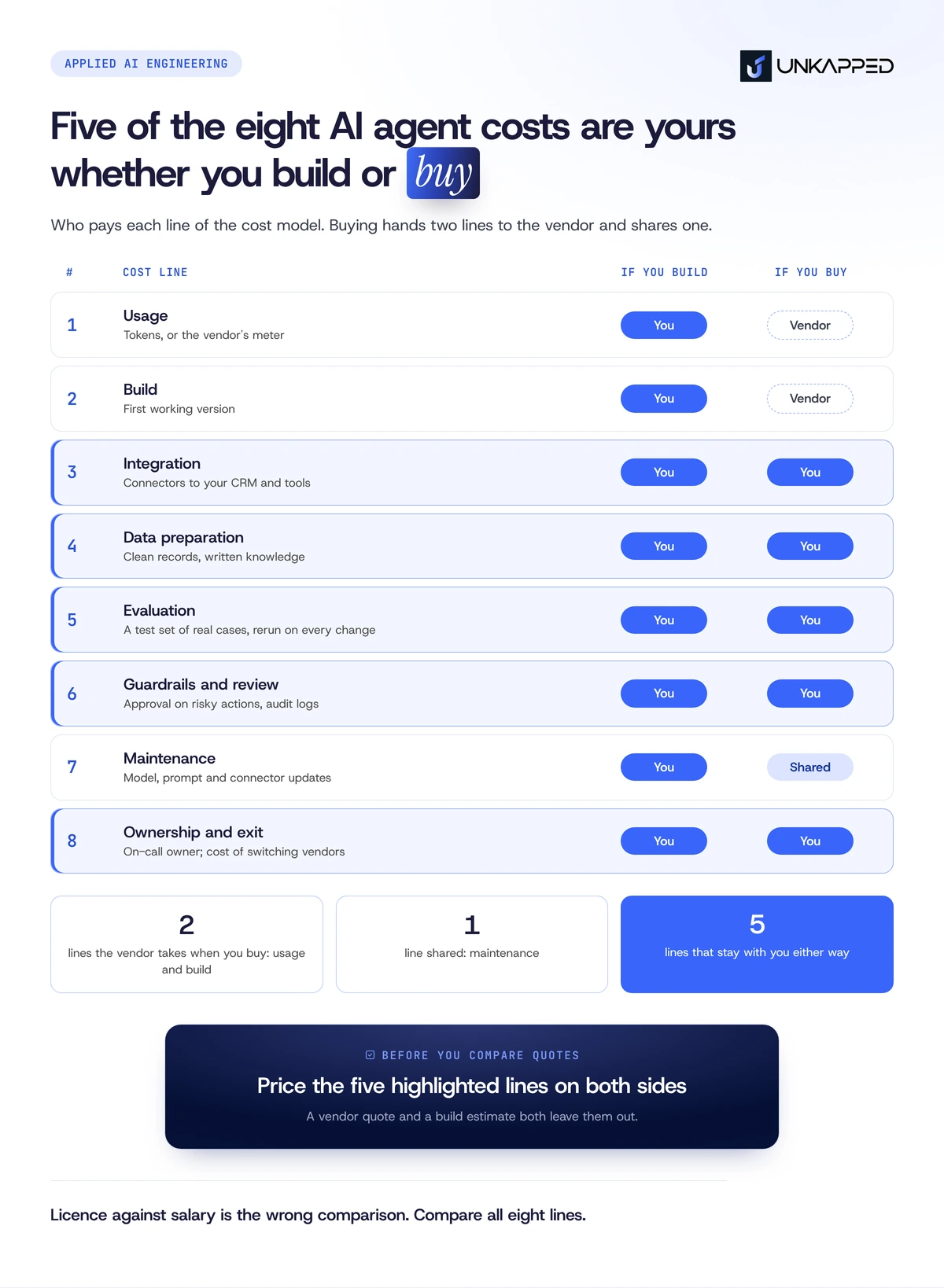
TL;DR: Build vs buy AI agents is eight cost lines, not two. Buying moves usage and build to the vendor; integration, data, evaluation, review and ownership stay with you either way.
How much does it cost to buy an AI agent?
AI agent pricing is now metered: buying an agent costs a fee that scales with how much the agent does, plus your own integration and review work. Salesforce Agentforce charges $0.10 per action or $2 per conversation, and Intercom Fin charges $0.99 per resolution. Price your real volume and the number of actions each task takes.
Salesforce's own Flex Credits explainer prices each action at $0.10 and shows a task running to several actions. A task that takes three actions costs $0.30, so 10,000 such tasks a month is $3,000 before anything else on the list. Intercom's pricing page charges $0.99 per outcome, so the same 10,000, if all resolved, is $9,900.
On the buy side of build vs buy AI agents, two checks matter more than the headline price. First, count actions on your real tasks, not the vendor's demo; complex workflows fan out. Second, read what counts as a billable outcome. Then add lines 3 to 8 from the table, because the meter covers none of them.
How much does it cost to build an AI agent?
Building an AI agent costs engineer time for the first version and for every change after it, plus model usage at your provider's token prices. No honest figure fits every agent: a single-system agent and one that writes to three systems differ by months of work. Price it in engineer-months per phase, then multiply by your loaded cost: salary plus benefits, tax and overhead.
AI agent development cost splits into four phases, and teams usually price only the first:
1. First version. The agent's logic, prompts and tool calls, working on sample data.
2. Integration and data. Connectors to your systems, permission scopes, and the clean records the agent relies on.
3. Evaluation and guardrails. A test set of real cases with expected outcomes, approval steps on risky actions, and logging.
4. Run. Model usage, monitoring, fixing what breaks, and updating prompts and tests when the model or your process changes.
Model usage is the easy line to calculate: tokens per task, times your provider's price per token, times volume. Check the current price on your provider's pricing page, because model prices change often. Phases 2 to 4 are where build estimates go wrong, and they recur every time the workflow changes.
On the build side of build vs buy AI agents, ask whoever will build it for engineer-months per phase in writing, including the run phase per quarter. A build estimate with no run line is a prototype estimate.

What does the evidence say about build vs buy for AI?
The evidence favours buying for most workflows. MIT's NANDA initiative found in 2025 that AI tools bought from specialised vendors or built with partners succeeded about 67 per cent of the time, while internal builds succeeded about a third as often. Building still wins where the advantage is in your own data or process.
The same MIT research, reported by Fortune, found about 95 per cent of enterprise generative AI pilots delivered no measurable profit and loss impact. The study drew on about 150 leadership interviews, a survey of 350 employees and 300 public deployments, so its success rates are reported, not audited; treat them as direction, not a forecast for your project. The report's lead author said enterprises nearly everywhere were trying to build their own tools, but purchased solutions delivered more reliable results.
Gartner predicted in June 2025 that over 40 per cent of agentic AI projects will be cancelled by the end of 2027, citing escalating costs, unclear business value and inadequate risk controls. It also estimated that only about 130 of the thousands of vendors claiming agentic products offer real agentic capability.
Read together, the two say the same thing about build vs buy AI agents cost models. Projects fail on the lines teams did not price: integration, evaluation, risk controls and ownership. Buying helps because a good vendor has already paid for some of that work. It does not help if you buy an agent that is a renamed chatbot, or skip the lines that stay with you.
How do you run the build vs buy AI agents cost model?
Run the cost model in six steps, before any vendor demo or prototype. Define the task, count real volume and actions, price both options on all eight lines, add the switching cost, and choose. The person who will own the agent in production should fill it in, not the person selling or building it.
1. Write the task in one sentence, with its input, output and the system it changes. The workflow owner does this.
2. Count real volume: tasks per month now and in a year, and actions per task from ten real examples. RevOps or the operations lead supplies the data.
3. Price line 1 for both options: the vendor's meter at that volume, and your model usage at current token prices.
4. Price lines 2 to 7 in engineer-months, from the people who would do the work, then convert at your loaded cost.
5. Price line 8: name the on-call owner, and for the bought option, what it costs to leave in year two.
6. Compare 24-month totals, not first-year costs. Build costs land early; metered costs grow with volume, so the first year flatters buying.
If the build vs buy AI agents totals are close, choose by the rule in the next section, not by the difference.
When should you build, buy or do both?
Buy where the workflow is generic and a vendor already sits in the system it changes. Build where the agent depends on data or a process that sets you apart. Do both when a bought agent covers the common path and a built one handles the part only you can do.
Whichever way build vs buy AI agents comes out, the work on lines 3 to 6 is the same, and so is the need for someone accountable after go-live. That is the role a forward deployed engineer fills when a team builds inside its own stack.
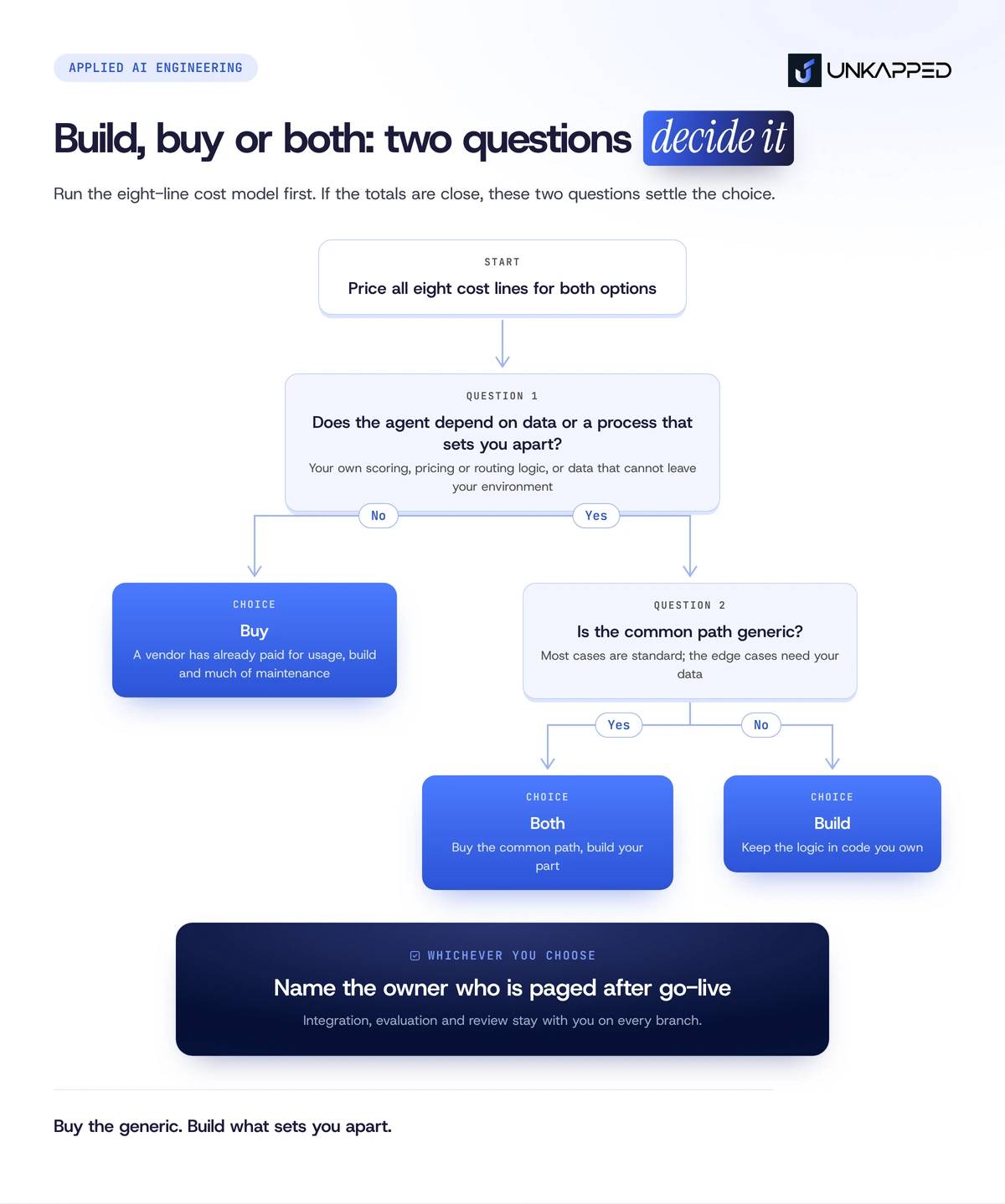
TL;DR: Run the eight-line model over 24 months, then buy the generic and build what sets you apart. Price integration, evaluation, review and ownership on both sides, because they do not go away.
What to do next
To settle build vs buy AI agents, write the task in one sentence, pull ten real examples, and fill in the eight lines for both options with the person who will own the agent. If you want help building the model or the agent, book the audit and we will price both options with you.
Is it worth building an AI agent?
Building an AI agent is worth it when it depends on data or a process that sets you apart and you have someone to own it in production. For generic tasks, buying is usually cheaper and, on MIT's 2025 evidence, more likely to succeed.
What is build vs buy in AI?
Build vs buy in AI is the choice between developing an AI system with your own engineers and model providers, or licensing one from a vendor. For build vs buy AI agents it covers more than the software: integration, testing, review and ownership costs apply either way.
How much does an AI agent cost per month?
A bought AI agent costs its usage meter plus your own integration and review work. At Salesforce's $0.10 per action, 10,000 three-action tasks is $3,000 a month in usage alone; at Intercom Fin's $0.99 per resolution, 10,000 resolutions is $9,900. A built agent costs model usage plus the engineer time to run and maintain it.
What hidden costs do AI agents have?
The hidden costs are integration with your systems, cleaning the data the agent relies on, building and rerunning a test set, human review on risky actions, maintenance when models or processes change, and the cost of switching vendors later. Most quotes and estimates leave them out.
Can you start with a bought agent and build later?
Yes, if you keep your test cases, prompts and process documentation in your own systems from day one. They are what makes a later build, or a switch to another vendor, quick. Without them, you start again.