AI Change Management: Why Adoption Stalls After The Build Ships
How do you ensure AI actually embeds into your process and everyone is onboard that change? Read this blog on the latest insights on AI change management.
Executive summary
- For a COO whose AI build shipped but sits unused: the AI change management checks that find which of five causes is stalling adoption, and what to change in the next 90 days.
- Adoption stalls after launch when an AI build is handed over as software instead of as a change to how the work gets done.
- In our view, five checks sit behind most stalls: an owner for the workflow, the AI placed inside the step, the old path closed, trust users can see, and a measure of the work.
- Training fixes what people know. It does not change who owns the workflow, who carries the blame when the AI is wrong, or what managers measure.
- Decide at day 90 whether to expand, narrow or retire the build, judged on the share of the work it now does, not on licence counts.
The build passed its tests and went live. Three months on, the usage report shows a spike in the first week and a slow decline since, and the renewal is due. If you are the chief operating officer (COO) or transformation lead who sponsored that build at a company of 500 or more people, this guide is for you. AI change management, as we use the term here, is the work that turns a working system into the way a job gets done, and most of it happens after launch. You will be able to read your own data for the five causes we think sit behind most stalls, give each fix an owner, and run a 90-day plan that ends in a clear decision.
The problem is common. WalkMe, an SAP company that sells digital adoption software, surveyed 3,750 executives and employees at companies with 1,000 or more staff. It reported on 9 April 2026 that 54 per cent of workers had bypassed their company's AI tools at least once in 30 days. Our position is that a build which goes unused was usually handed over as software, not as a change to the work. The fix is an operating change with a named owner, not another round of training.
What is AI change management, and why does it start after the build ships?
AI change management is the work of making an AI system the normal way a job gets done. It settles who owns the workflow, where the AI sits in it, what happens to the old way of doing the task, how users judge the output and what gets measured. Most of that work starts after launch.
Writing on AI and change management mixes two meanings. The second is using AI to run change program, for example to draft communications or read staff surveys. We use the term in the first sense here, as change management for AI adoption.
An AI rollout differs from a typical software rollout in three ways that matter after launch. The output is probabilistic, so users decide case by case whether to rely on it, and one visible mistake can shape a whole team's view. The old way of doing the task keeps working unless someone closes it, because the AI usually sits alongside an existing process. And the person who approves the output often carries the blame when it is wrong, even though they did not write it.
Prosci, the change management research firm, separates implementation from adoption: implementation makes AI tools available, and adoption makes them part of everyday work. We agree, and add a test. A system is adopted when the share of the target work running through it is high and stable. The share of license holders who logged in does not tell you that. Put to a chief executive, deployed means the system is available, and adopted means the work now runs through it.
How do you know adoption is stalling in the first 30 days?
Look at the work, not the log-ins. The early signs are use that peaks in week one and decays by week four, and tasks still finished the old way. Watch for high edit or override rates, use concentrated in a few people, and managers who never mention the system. Each sign points to a different cause, so read them together.
Most of these signals already sit in your systems. The AI system's logs show use by week, person and task type. The old system shows whether the same task is still done there: the template still edited daily, the shared inbox still answered, the spreadsheet still updated. Review records show how much of each draft people change before approving it. Team meeting agendas show whether managers ask about the new way of working.
Two signals are easy to misread. In our reading, a support channel that goes quiet in week three means people have stopped trying more often than it means they have learnt. An override is not always a bad sign either: users should be able to overrule the system. A high override rate in one task type is different, because users are telling you they do not trust the output there.
Survey data on enterprise AI adoption points the same way. In WalkMe's 2026 research, 29 per cent of workers stopped using AI mid-task for lack of guidance, and 45 per cent had used unsanctioned AI tools in the previous 30 days. When people use a personal chatbot for the task your system was built for, the sanctioned path is slower or harder than the workaround.
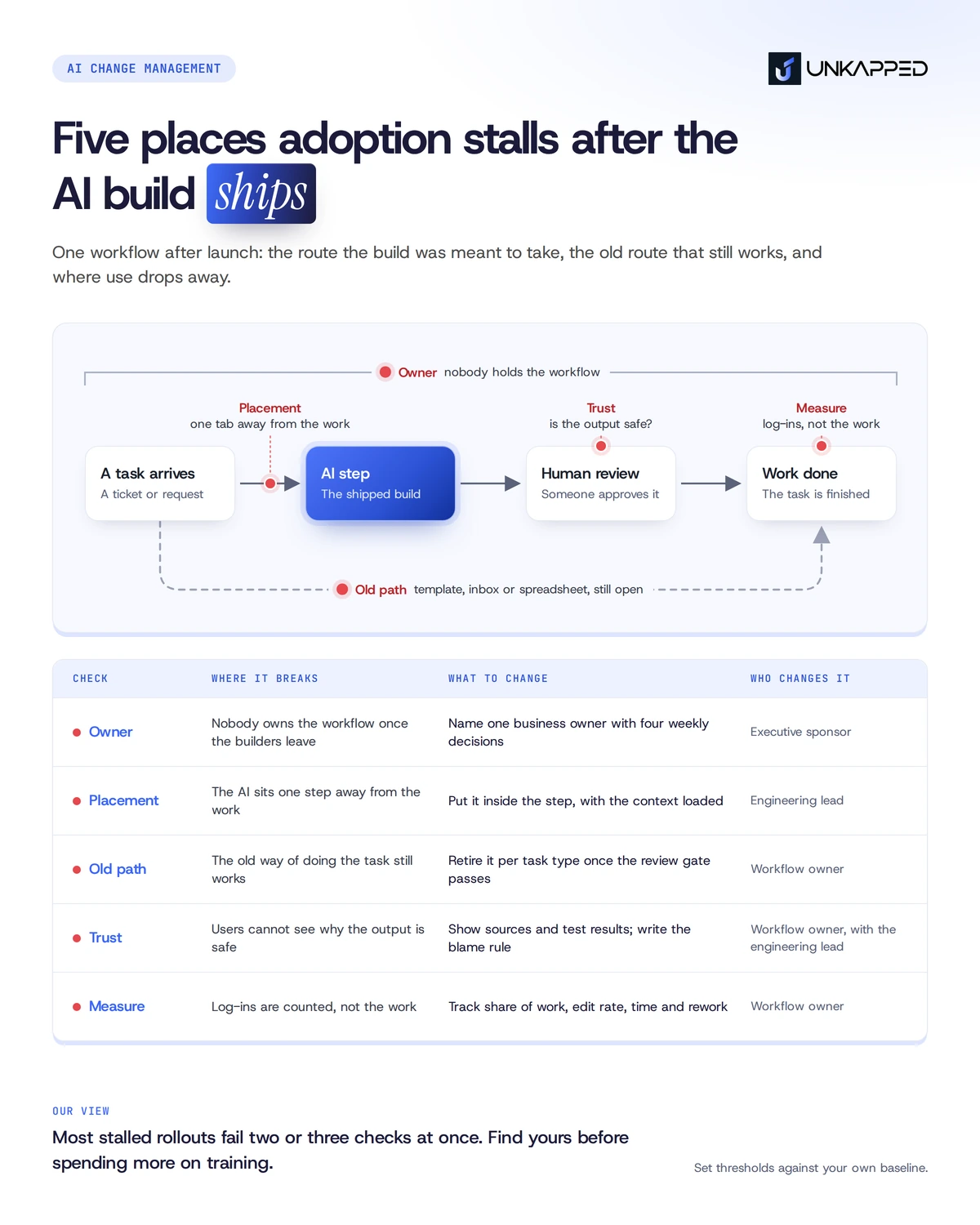
Use the table, which is our reading rather than measured data, to match what you see to the check that is failing. Set your thresholds against your own pre-launch baseline. We do not publish benchmarks, because existing baselines differ vastly.

Why does adoption stall after the build ships?
Our view is that five causes sit behind most stalls. Nobody owns the workflow once the builders leave. The AI sits outside the step where the work happens. The old way still works. Users cannot see why the output is safe to rely on. And the measure is log-ins rather than the work.
In our view, most stalled rollouts fail two or three of these checks at once, because the checks compound. Without an owner, nobody closes the old path. With the old path open, the usage report falls and nobody has the authority to change it. Without visible trust, users take the old path whenever the stakes rise. Fixing one check rarely moves the numbers on its own. That is why a rollout can absorb a training program and a champions network and still decline. Each check below ends with what to change and who changes it.
Who owns the workflow once the builders leave?
One named person on the business side, who owns the workflow's results rather than the tool's uptime. They decide which task types the AI handles, approve changes, read the misses every week and answer for the service level. When ownership sits with IT, a vendor or a steering group, nobody has the authority to change the workflow, so use drifts.
The usual split looks reasonable on paper. IT owns the licenses and uptime. Human resources (HR) or learning owns the training calendar. The business owns the results. Adoption has no owner. The builders, an internal team or a forward deployed engineer, move on. The questions that decide adoption go unanswered: which task types go through the system, what happens to the old template, who reads the drafts users rejected.
Give the role to the person accountable for the work: the head of sales engineering for a questionnaire agent (an AI system that drafts answers to customer security questionnaires), or the head of support for a reply drafter. Do not give it to the person who built the system. The owner's week has four fixed decisions:
- Which task types the system handles by default.
- Which changes to the system to approve.
- Which misses to send back to the engineers.
- Whether the service level held.
Write those four decisions into the handover before the builders leave. Our forward deployed engineer guide covers the handover and the exit test that should carry them.
Is the AI inside the step where the work happens?
If using the AI means opening a separate tab, copying context in and pasting results back, it adds steps to the job, and people drop it on a busy day. Put it inside the system and the step where the task already happens, with the context it needs loaded, so that using it is the shorter path.
A research brief that a sales development rep has to fetch from a separate app and paste into the customer relationship management (CRM) record is extra work. The same brief already on the account record is not. In our view, many copilot adoption problems are this gap: a copilot, an AI assistant built into an existing application, sitting one step away from the work. Lian Jye Su, chief analyst at Omdia, put the rule plainly to TechTarget:
"Make the approved path faster than the workaround."
The engineering lead fixes it: map the steps users take today and remove the clicks the AI adds before adding features.
Why does the old way of doing the task still work?
Because nobody closed it. While the old template, inbox or spreadsheet stays open and equally valid, people take the path they know, especially under time pressure. Retire the old path one task type at a time, once the AI passes its review gate for that type: the test set of past cases and the approval step it must clear.
In our view, the open old path is the most common silent cause, because the build was scoped as an addition and nobody decided to close the old process. Closing it is not a usage mandate: it changes where the work goes.
The workflow owner makes the change. Once a task type passes its gate, new requests open in the AI queue and the old template goes read-only for that category. Keep an exception route and count its use; a rising count points at the build, not the users.
Can users see why the output is safe to rely on?
Users rely on output when they can see what it was checked against and who answers for errors. Show the sources on each output and show that the task type passed its test set. Keep a human approval step where errors are costly. Make clear that a reviewer who follows the approved process is not blamed for an AI miss.
Harvard Business Review reported on 25 September 2026 on an argument by Harvard Business School professor Das Narayandas: people override AI systems that work well because, when the AI is wrong, the cost lands on their careers. WalkMe found that 9 per cent of workers trust AI for complex, business-critical decisions, against 61 per cent of executives.
The workflow owner and the engineering lead fix it together. Show users the same test sets, evaluations and review gates that exist before launch. Write the blame rule down: a reviewer who follows the approved step is not blamed for a miss the step was not designed to catch. When a visible error happens early, add the case to the test set and tell the team what changed.
Are you measuring the work or the log-ins?
Measure the share of the target work that now runs through the AI, the edit or override rate, the time to finish the task and the rework downstream, each against a baseline taken before launch. Log-ins and license counts tell you who opened the tool, not whether the work changed.
If a chief information officer (CIO) asks how to measure AI adoption, give them four AI adoption metrics:
- Share of work: target tasks completed through the AI path, divided by all target tasks, from the AI logs and the old system.
- Edit or override rate: the share of outputs changed substantially or rejected, by task type, from review records.
- Time to finish: request to completed task, from workflow timestamps.
- Rework: corrections, escalations or returns, from the next team's queue.
The workflow owner reads them weekly for 30 days, then every two weeks.
What do published rollout write-ups show?
Read against the five checks, three public write-ups agree on ownership and sponsorship, and two of the three address placement or trust. Their measures are mostly usage. None describes closing the old way of doing the work. All three cover general-purpose assistants rolled out company-wide, not single-workflow agents.
The sources are Atlassian on its own rollout (diginomica, partner-authored, 23 July 2026), Prosci's United Concordia Dental case study (updated 20 August 2026) and McKinsey on its Lilli platform (13 August 2025).
All three come from organizations with an interest in the result: a sponsored article, a vendor case study and a consultancy on its own platform. Their silence on the old path is a gap in what gets published: a company-wide assistant has no single old path to close, but a single-workflow agent does.
TL;DR: AI adoption stalls after launch when the workflow has no owner, the AI sits outside the step, the old path stays open, users cannot see why output is safe, or the measure is log-ins. Find which of these five checks your rollout fails before spending more on training.
Why doesn't training fix a stalled AI rollout?
Training fixes what people know. It does not change who owns the workflow, where the AI sits, whether the old way still works, who carries the blame for errors or what managers measure. While those stay the same, trained people drift back to the old way, because it is still easier and safer.
Training still matters: Prosci attributes 38 per cent of AI adoption challenges to insufficient training, and puts the half-life of AI skills at three to four months. But in a McKinsey survey cited in its change management article, nearly as many US employees said workflow integration would make them use generative AI more (45 per cent) as said formal training would (48 per cent). In our reading, AI transformation change management plans fund the training and skip the integration.
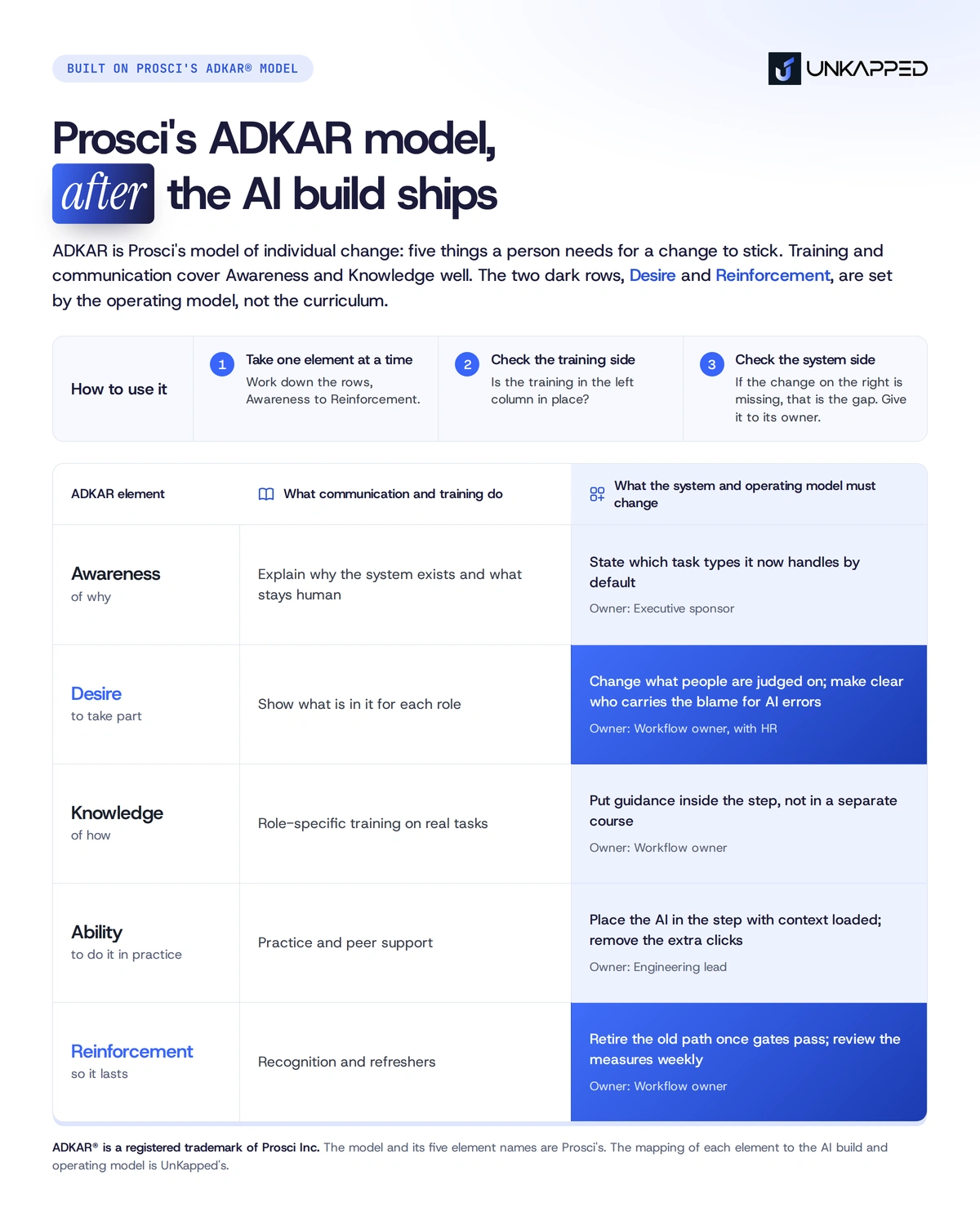
Prosci’s ADKAR model, often used as an AI adoption framework, shows why. Training covers Awareness and Knowledge. Desire and Reinforcement depend on what people are rewarded and blamed for, and on which path is the default, so the operating model sets them. John Kotter’s eight-step change model ends on the same point: change lasts when it is anchored in how the organization works.
Two things carry over from classic change management: visible sponsorship, and briefing managers before their teams, since Prosci finds mid-level managers the most resistant group.
Should you mandate AI use to fix adoption?
No. Mandating use produces compliance: people open the tool to show activity and keep doing the work the old way. Harvard Business School researchers call this symbolic adoption. Change the default path for the work instead, keep a way for users to overrule the system, and judge people on the work.
When a rollout meets resistance to AI adoption, the tempting answer is a mandate: usage targets, or threats to remove licenses from people who do not use the tool. Both raise log-ins. Neither changes where the work goes.
Das Narayandas and Shunyuan Zhang of Harvard Business School explain why (Working Knowledge, 24 June 2026): AI can shrink a role’s judgement, control and influence even when the title stays the same, so people comply while working around the tool. Narayandas told HRD, the Human Resources Director magazine, that announcing AI plans alongside headcount targets makes it worse.
Their fixes fit the five checks: name the judgement that becomes more visible once routine work is automated, keep a guardrail so users can overrule the system, and have senior leaders put their names on the redesigned role. Add the operating changes: close the old path one task type at a time, and judge teams on the work, not log-ins.
TL;DR: Training and communication shape what people know and hear. They do not change the defaults, the accountability or the measures that decide what people do. Use change management models such as ADKAR to find the gap, then change the system and the operating model to close it.
What does a 90-day adoption plan look like after the build ships?
Write the adoption criteria into the build's exit test before launch, then run three 30-day stages. Stabilize the workflow and fix the top frictions. Retire the old path for task types that pass their gates. At day 90, decide whether to expand, narrow or pause, based on the work the system now does.
Use the plan below as the AI adoption roadmap for one workflow. It treats adoption as part of the build, not a program that starts after it. Each step has an owner:
- Before launch, write the adoption criteria into the build's exit test: the target task types, the baseline and the measure that means "adopted". Owner: the workflow owner, with the engineering lead.
- In days 1 to 30, read the stall signals weekly and fix the top two frictions in placement and trust. Owner: the workflow owner.
- Also in days 1 to 30, brief managers on what changes in their team's work and what they will be judged on. Owner: the workflow owner, with the executive sponsor.
- In days 31 to 60, retire the old path for each task type that has passed its review gate, keeping a documented exception route. Owner: the workflow owner.
- Also in days 31 to 60, add the task types users override most to the test set, and show the result on the output. Owner: the engineering lead.
- In days 61 to 90, compare the measures with the baseline and decide to expand, narrow or pause. Owner: the executive sponsor, on the owner's evidence.
The table sets out who leads each stage and when to move on. Do not move to the next stage on the calendar alone.
The day-90 decision follows from the measures. Expand when the share of work is high and stable, the edit rate is falling and rework has not risen. Narrow when some task types meet the criteria and others do not: keep the ones that work and close the rest. Pause when users still do not trust the output after the fixes, or when the owner cannot change how the team works. Pausing at day 90 is cheaper than renewing a system the work goes around.
TL;DR: A post-launch adoption plan works when each 30-day stage has an owner, fixes for named checks and a criterion for moving on. Decide at day 90 to expand, narrow or retire the build, judged on the share of the work it now does.
What does a stalled rollout look like in practice?
Illustrative example: the security questionnaire agent from our forward deployed engineer guide, ten weeks after handover. Use fell from most new questionnaires to under a third within two months. The signals pointed to two of the five checks: the old answer library was still open, and users rewrote drafts in two product areas the test set did not cover.
Every number in this example is illustrative and describes no client or result. The company is a cloud security business of about 1,500 employees. Its 12 solutions engineers answer customer security questionnaires, and an agent now drafts the first answers. In the first fortnight after handover, 31 of 40 new questionnaires started in the agent. In weeks seven and eight, 11 of 38 did.
The owner, the head of sales engineering, reads the signals in week nine. The old answer library document is still edited every day, so the old path is open. Drafts for two product areas are rewritten almost entirely, so trust has failed there. Most of the remaining use comes from three of the 12 engineers, so the default has not changed for the rest.
The fixes follow from the diagnosis, and none is a training session:
- New questionnaires open in the agent's queue by default.
- The old library becomes read-only for every category whose review gate has passed, with an exception route the owner approves.
- The engineering lead adds the two product areas to the test set, and each draft now shows the sources it used.
At day 90, the sponsor compares turnaround time and rework with the pre-launch baseline. If the agent now handles most of the work in the categories that passed, the next decision is whether to extend it to requests for proposal. If it does not, the team narrows the agent to the categories that work.
When should you stop pushing adoption and change the build instead?
When the stall comes from the build, not the rollout. That means the system solves a problem users do not have, it cannot pass its review gate for the task, or checking its output takes longer than doing the work. Then more change management wastes time. Narrow the scope, rebuild the weak step or retire the system.
Some AI projects fail after launch because they should not have been built in that form. The signals look like the rollout signals, which is why the owner needs the build-side view too. Three tests separate them:
- Wrong problem. Users bypass the system even where it works well, because the task it speeds up was never their bottleneck.
- Failed gate. The system keeps failing its test set for a task type after two rounds of fixes.
- Review burden. Checking and correcting the output takes longer than doing the task by hand. Time to finish rises after launch instead of falling.
The five-check approach works for a build with a clear target workflow and an owner who can change it. It will not hold when the build was a general assistant with no target workflow, because there is no single old path to close and no single measure of the work. There, the published playbooks on sponsorship, champions and coaching are the better starting point.
Retiring a build is a valid outcome. Record what the test set taught the team, keep the integrations that work, and use both in the next build.
What is the strongest case against this view?
The strongest case is that adoption is a human problem first. People avoid AI because it threatens their skills and standing, and no workflow change fixes that fear. Prosci and Harvard Business School researchers make versions of this case, and they are right that identity matters. Our view is that the operating model sets the terms people respond to.
Narayandas and Zhang argue that symbolic adoption is a reasonable response to a real loss: less authority, less visible expertise, a smaller role. Prosci's research puts human factors at the centre, with 63 per cent of organizations naming them as a primary challenge in AI implementation. We accept both findings. A rollout that ignores what people stand to lose will stall, whatever the workflow looks like.
Where we differ is on order. Fear responds to what the organization does, not to what it says. A clear owner, a rule that protects reviewers from blame for AI misses and a measure that values judgement change what people stand to lose. The researchers' own fixes, such as decision guardrails and a redefined role, are operating changes too.
Our view would change if published post-launch data showed rollouts that added only training, communication and champions reaching the same sustained share of work as rollouts that changed ownership, placement and the old path. We have not seen that data, and we have no rollout data of our own yet.
What is the difference between AI implementation and AI adoption?
Implementation makes an AI system available: it is built and switched on. Adoption makes it the way the work gets done. The test is the share of the target work that now runs through the system, measured against a baseline. A system can be fully implemented, with every licence assigned, and barely adopted, if people still finish the task the old way.
How long does AI adoption take after go-live?
There is no fixed time. Plan in 30-day stages and decide at day 90 whether to expand, narrow or pause. The pace depends on how many task types the system handles and how fast each passes its review gate, since the old path closes one task type at a time. A narrow agent can settle within the 90 days. A broad assistant, with more task types to pass, takes longer.
How is AI used in change management?
AI can run parts of a change programme: drafting communications, summarising staff feedback, analysing survey sentiment and answering routine questions about a change. That is the second meaning of AI change management. This guide covers the first meaning, the change needed for people to adopt an AI system. The two can meet, for example when an assistant answers questions about the new workflow inside it.
What is the ADKAR model?
ADKAR is Prosci's model of individual change: Awareness of why, Desire to take part, Knowledge of how, Ability to do it in practice and Reinforcement so it lasts. Prosci uses it to plan communication, training and coaching person by person. For an AI build, the table in the training section maps each element to what the system and operating model must change.
Why do AI pilots fail to reach production?
Mostly for reasons that come before adoption. The pilot ran on clean sample data, integration with live systems was not scoped, security approvals stalled, or nobody wrote the test set the system must pass. Those are build and access problems, a different stage from a live system nobody uses. Our forward deployed engineer guide covers how to set up that stage.
Does shadow AI mean our AI rollout has failed?
Not on its own. When staff use personal AI tools for a task your system covers, the sanctioned path is slower, harder or missing something. Find that task and fix the placement or the gap. Keep the policy on approved tools and data clear too: WalkMe found 45 per cent of workers had used unsanctioned AI tools in 30 days, and 36 per cent had done so with confidential data.
How do you measure the return on investment (ROI) of AI adoption?
Tie the value to the work measure you set before launch: time to finish the task, rework downstream and the volume the same team now handles, each against the baseline. Multiply the time saved by the cost of the people doing the task, and subtract the cost of running and reviewing the system. Without a pre-launch baseline, any return figure is an estimate. Say so.